
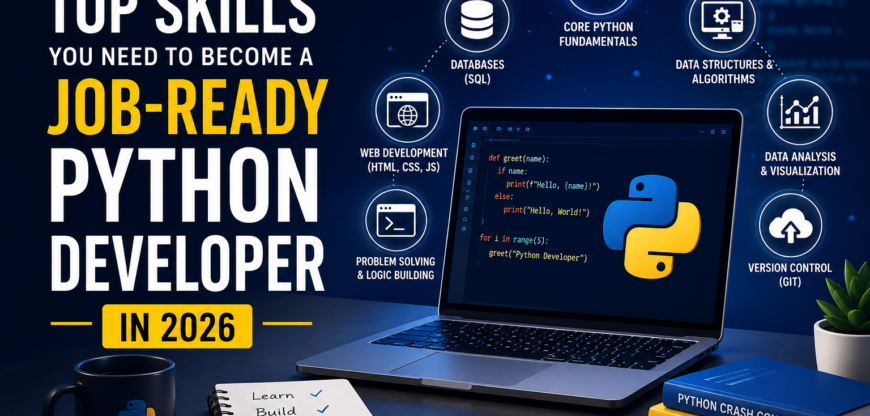
Python remains one of the most in-demand programming languages in the world in 2026 — but recruiters have raised the bar. Employers now expect Python developers to bring a mix of practical, specialized skills and real project experience, not just knowledge of syntax. If you’re a student, fresher, or career switcher aiming to land your first Python developer job, here are the 10 skills that actually get candidates hired this year.
Quick Answer: The 10 Python Developer Skills Employers Want in 2026
- Core Python fundamentals & OOP
- A web framework — Django or Flask/FastAPI
- SQL and database design
- Git and version control
- Cloud basics (AWS, Docker, Kubernetes)
- Data handling skills (pandas, APIs)
- AI / GenAI integration
- A real project portfolio
- Debugging and testing
- Communication and problem-solving
Below, we break down each one — and why it matters for your job search.
1. Strong Python Fundamentals — Not Just Syntax
Before anything else, you need rock-solid basics: variables, data types, loops, functions, and — critically — object-oriented programming. A strong understanding of classes, objects, inheritance, polymorphism, encapsulation, and abstraction forms the foundation for learning advanced frameworks and tools later. Don’t rush past this stage — recruiters can usually tell within the first five minutes of a technical interview whether your fundamentals are shaky.
2. At Least One Web Framework (Django or Flask/FastAPI)
Writing scripts isn’t the same as building applications. You need hands-on experience with a real framework: Django for full-featured, database-driven apps, or Flask/FastAPI for lightweight APIs and microservices. This is where “I know Python” turns into “I can build something people will actually use.”
3. Databases and SQL
Almost every real-world Python application talks to a database. Learn how to design schemas, write queries, and connect your application to MySQL or PostgreSQL. Recruiters increasingly test this directly, because it separates tutorial-followers from developers who can ship a working product.
4. Git and Version Control
If you can’t confidently use Git — branching, committing, resolving merge conflicts, collaborating on GitHub — you’ll struggle on any real team, even as an intern. This is one of the fastest wins on this list: it takes a few days to learn and instantly makes your resume look more professional.
5. Cloud and Deployment Basics
This is the skill most self-taught learners skip — and it’s now one of the biggest differentiators in 2026. Cloud platforms show up in over 60% of Python job listings, with AWS alone appearing in 62% of them, and Docker and Kubernetes close behind. You don’t need to be a DevOps expert, but you should be comfortable deploying a Python app, working with Docker containers, and understanding what a cloud platform actually does.
6. Data Handling Skills (Even If You’re Not a “Data Scientist”)
You don’t need to become a machine learning engineer to benefit from data skills. Basic experience with pandas, or working with APIs that return structured data, makes you significantly more versatile. Python developers who combine SQL with data-pipeline experience consistently score higher in job matching than those with web-framework-only backgrounds.
7. AI and GenAI Familiarity
You can’t ignore this one in 2026. Python Full Stack combined with GenAI has become one of the strongest learning directions for 2026 and beyond. This doesn’t mean training models from scratch — but understanding how to call an AI API, work with prompts, and integrate AI features into an application is quickly becoming a baseline expectation, not a bonus.
8. A Portfolio of Real Projects — Not Just Certificates
This is the single biggest gap between candidates who get hired and candidates who don’t. <cite index=”16-1″>A recent survey found that 67% of hiring managers for Python roles now de-emphasize degree requirements in favor of portfolio evidence</cite>. Certificates prove you attended a course; projects prove you can build something. Aim for 2–3 solid projects that solve a real problem — not another to-do list clone.
9. Debugging and Testing
Beyond writing code, employers expect you to be able to find and fix what’s broken. Comfort with debugging tools, writing basic unit tests, and reading stack traces without panicking is a strong signal of production-readiness — something tutorials rarely teach well.
10. Communication and Problem-Solving Skills
Technical skill gets you the interview; communication gets you the offer. Recruiters look for a combination of technical skill, project understanding, problem-solving ability, and the ability to explain your work clearly — many candidates complete tutorials and collect certificates but still struggle when asked to walk through their own project in an interview.
Is Python Still in Demand in 2026?
Yes — emphatically. The supply-demand gap for mid-to-senior Python developers in the US alone sits at roughly 22,000 unfilled positions as of early 2026, a gap expected to persist for at least 18–24 months, driven largely by AI adoption spreading beyond big tech into healthcare, finance, and manufacturing.
FAQs: Python Developer Skills in 2026
Q: Is Python still worth learning in 2026? Yes. Python continues to lead in web development, data science, automation, and AI, and demand for skilled developers remains strong across industries.
Q: Do I need a computer science degree to become a Python developer? No. Hiring managers increasingly prioritize portfolio evidence and practical project experience over formal degrees.
Q: Which Python framework should I learn first — Django or Flask? Django is better if you want to build full, database-driven applications quickly. Flask or FastAPI is better if you want to understand APIs and microservices from the ground up. Many job-ready developers eventually learn both.
Q: How long does it take to become a job-ready Python developer? With focused, project-based training, most learners can reach job-ready level in 4–6 months — faster than self-study alone, because structured programs combine fundamentals, frameworks, and real projects in sequence.
Q: Do I need to know AI/machine learning to get a Python job in 2026? Not deep ML expertise, but basic familiarity with calling AI APIs and integrating GenAI features is increasingly expected, even in general backend or full-stack roles.
The Bottom Line
The Python job market in 2026 isn’t shrinking — it’s maturing. The developers who stand out aren’t the ones who know the most syntax; they’re the ones who combine core Python, a framework, a database, basic cloud/deployment knowledge, and a portfolio that proves they can build real things.
If you’re serious about becoming job-ready rather than just “Python-familiar,” structured, project-based training with mentorship and placement support can shortcut a lot of this trial and error — closing exactly the gap most self-taught learners struggle with on their own.